


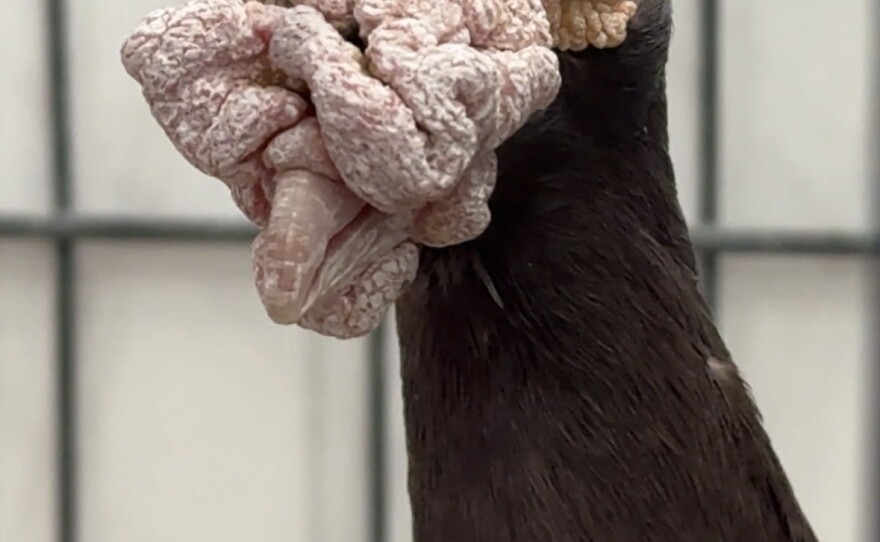
You've never seen pigeons like the ones at a fancy pigeon show — it's an avian beauty pageant. Among hundreds of cooing caged birds, some had iridescent purple and green feathers. Other breeds looked downright strange. One had a bulbous, warty-looking beak.
Breeders from across the country brought them to the Utah Pigeon Club's Salt Lake Premier Show in Grantsville, Utah, for judging.
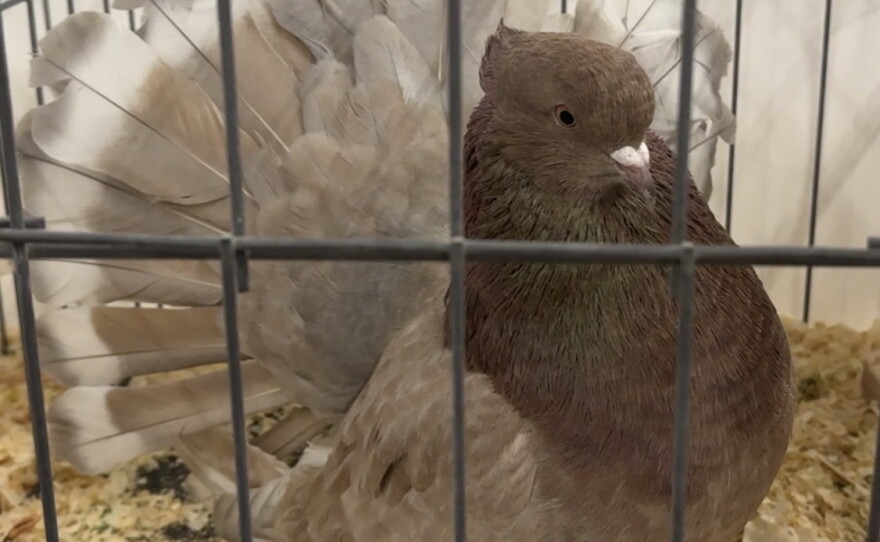
The fantails, as the name suggests, have a big fan of a tail — imagine a peacock-looking pigeon. Kevin Severson pulled one of his birds out of a cage and tidied its tail feathers, which were about 16 inches wide in all. He's been breeding pigeons since he was a kid and now has around 200.
"It's something that I can sit there and raise and just try to make something that's beautiful, and show it at a show, and have everybody go, 'Wow, look how beautiful that bird is,'" he said.
Severson is part of a long tradition. Humans have bred pigeons for at least a couple of thousand years. But now, breeders, called fanciers, say it's a way to get off screens and bond with other people and nature as Utah grows more urban.
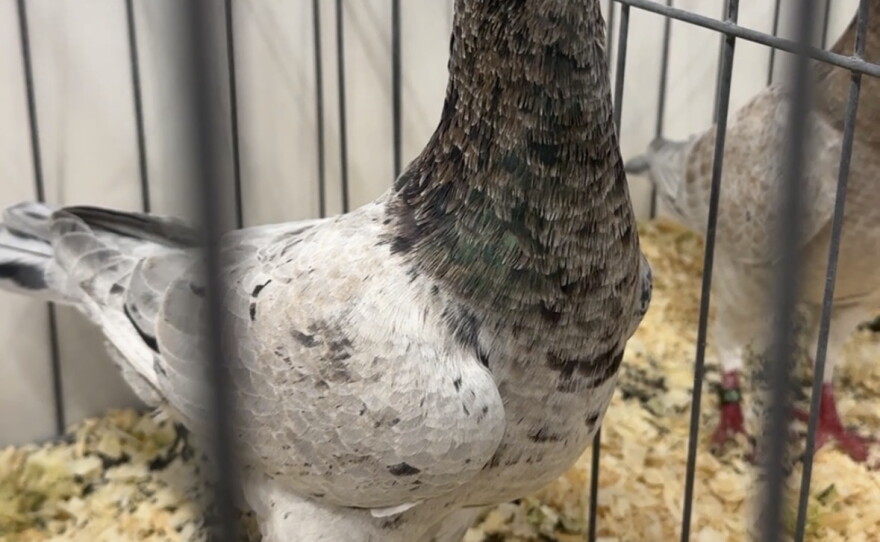
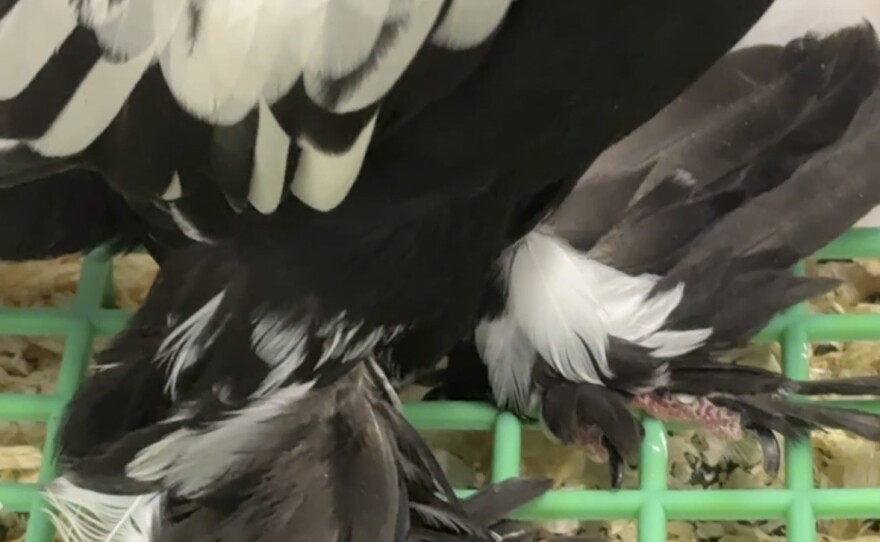
These birds do inspire awe. Another one at the show has a long neck that harkens back to its dinosaur ancestors. Surprisingly, many have long feathers splayed out on their feet. Even more surprising, that's a partial transformation of their legs into a wing, said University of Utah biology professor Mike Shapiro. It happens when wing-forming genes get turned on in the leg.
Crazy enough, these fancy birds all descend from a regular old pigeon: rock pigeons. But the ones you see in Northern and South American cities today aren't wild rock pigeons. They're feral descendants of escaped racing homer pigeons, Shapiro said.
Over the centuries, people bred rock pigeons for lots of different purposes.
"They were used for food. They were bred for fertilizer, of all things," he said. "They were also used for ceremonial purposes, and they've been used in combat to deliver messages from behind enemy lines."
Pigeon G.I. Joe got a medal for saving lives during combat in World War II.
Breeding for beauty started several hundred years ago, Shapiro said, and even Charles Darwin got into it. During Darwin's time, people couldn't believe fancy pigeons were all the same species, and he featured the birds in "On the Origin of Species" to show natural selection is everywhere.
The Grantsville pigeon show is for looks, but there are other shows. There are races where pigeons fly hundreds of miles to see how fast they can get to a location using their homing instincts. Hunter Siggard — who's been breeding for 20 years — has pigeons that compete in aerial acrobatics, like backflips.
"I think in a world where we have a little bit of a disconnect with nature and being creative, I think that raising pigeons allows us to be able to do that on small acreage in smaller yards, and still have that connection in a growing and kind of sprawling world," Siggard said.
As a friend walked by, he greeted him with an enthusiastic "Good to see you!" To him, the other breeders are like family, and the show is a reunion.
Community and camaraderie are part of why Henry Bastian, interim president of the national Classic Frill Club, breeds pigeons too. As he grabbed a bird out of its cage, the door squeaked, and it flapped nervously. The bird had a fluff of feathers sticking out on its white chest — Bastian compared it to George Washington's shirt ruffles.
"It's just amazing to see what these creations we have here on this planet," he said.
Pigeon breeding is about more than beauty. Shapiro, who studies genetics, said the birds can help scientists better understand human genes.
"Some of the same genes that are controlling differences in color in pigeons are controlling differences in pigmentation in us and are also important for things like susceptibility to disease, like melanoma and other types of skin cancer," he said.
Since one species shows so much variation, he wonders if there's something special about their genome.

Bastian, the classic frill breeder, is also passionate about pigeons and how they can help people, but in a different way. He wants to get more kids involved, like 12-year-old Declan Zilles. While many of his peers are on screens, Zilles spends most of his free time with his birds.
"I think it's a better use of your time because then you can fee the outdoors and see life happen really fast," he said.
Zilles saw the pigeons more as farm animals than pets, but he does sometimes name them after his cousins. He recommends breeding to other 12-year-olds because it's fun. Bastian hopes to get more youth into it to help them find connection to other people and life.
"This is another way that people get involved in the beauty and the creation — from the egg to seeing how that little squab grows and just transforms," he said. "It's just mind-blowing what we can do."
And a bonus is that it was a great show for Bastian, who won big in the classic frill category.
Copyright 2026 KUER 90.1